IBC tote recycling & reconditioning — reuse first, always
We follow the waste hierarchy: reuse > repurpose > recycle > dispose. Totes are triple-rinsed, hot-washed, pressure-tested, and re-caged or rebottled to go back to work. Only at true end of life do we granulate the HDPE and recycle the steel — diverting roughly 99% of every tote from landfill. Business customers can request a diversion certificate.
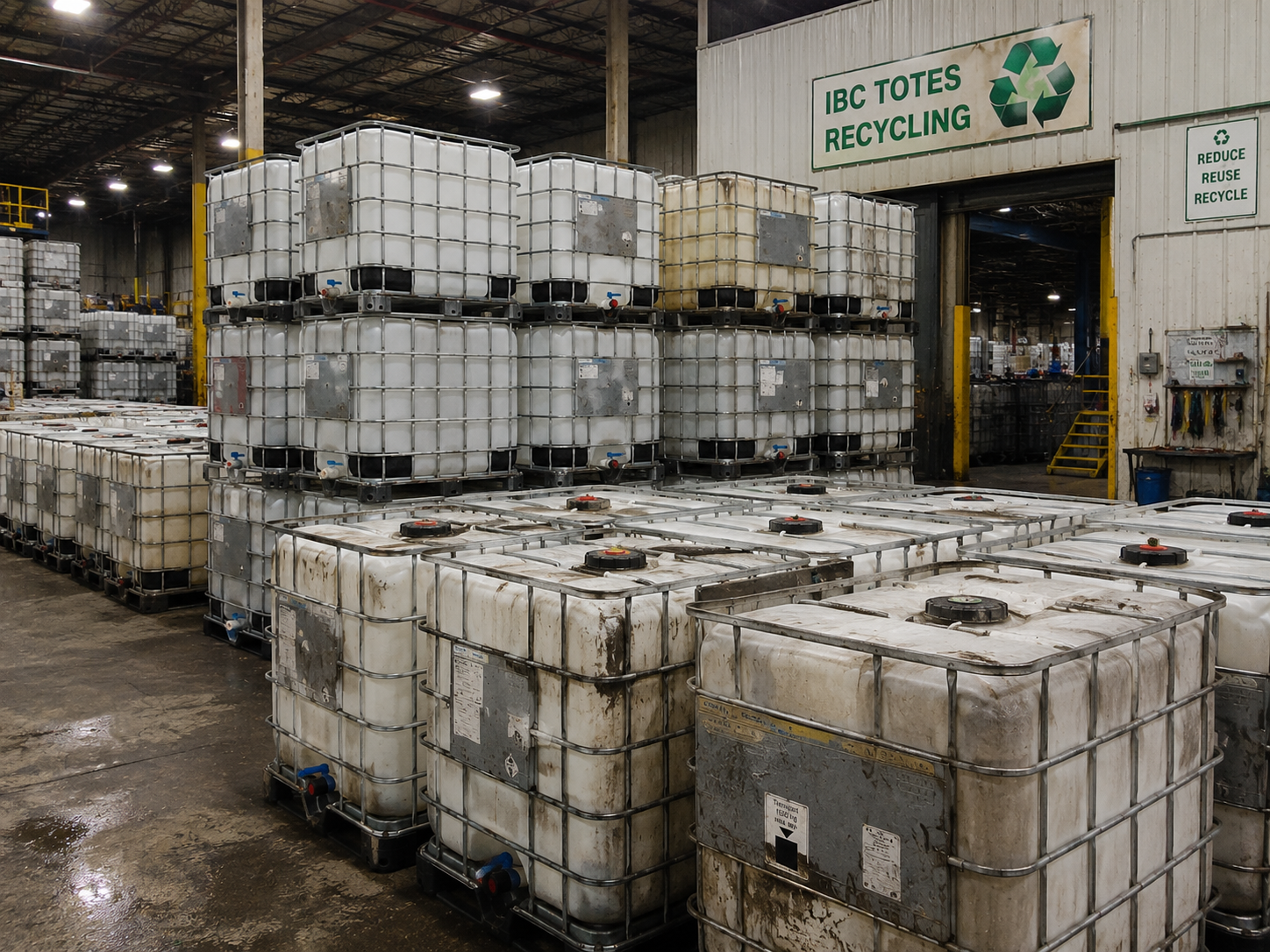
Recycling is the last resort, not the first. A ground-up tote loses the embodied energy of its original manufacture; a reused tote keeps all of it. That's why every tote enters our line assuming it will be renewed — and only exits to granulation when its integrity truly fails. Read the full argument in reuse vs. recycle.
The waste hierarchy
Four tiers, in order of impact
Reuse
Clean, test, re-cage, and send the same tote back to work. Highest material and energy savings.
Repurpose
When a tote can't hold liquid at spec, we upcycle it — rain barrels, planters, storage.
Recycle
Granulate HDPE into new plastic products; send the steel cage and pallet to metal recyclers.
Dispose
Reserved for the ~1% that truly can't be recovered. We work to shrink even that.
Reconditioning line
How we renew a tote
Triple-rinse
Three staged rinses flush residual product from the bottle, valve, and cap threads before any wash begins.
Hot-wash
A heated wash cycle removes films and residues; food-grade totes get an intensified protocol to meet edible-contact standards.
Pressure-test
Each vessel is checked for integrity. Totes that pass move to re-caging; those that fail are rebottled or recycled.
Re-cage & refit
Bottle is remounted in a sound, inspected steel cage on a fresh pallet, with valve and cap fittings checked or replaced.
Rebottle (when needed)
A worn bottle on a good cage gets a brand-new HDPE vessel — near-new performance while still reusing the heavy steel. Browse reconditioned totes.
End of life
Recovering the ~1% that can't be reused
When a tote finally retires, almost nothing goes to waste.
- HDPE granulation — the bottle is shredded and granulated into feedstock for new plastic products.
- Steel cage recycling — the tubular steel cage is baled and sent to metal recyclers.
- Pallet recovery — wood and composite pallets are reused or recycled.
- ~99% diversion — the sum of reuse, repurpose, and recycle across every tote we handle.
Do the math
See your reclaim impact
Enter how many totes you keep in the loop and watch the avoided virgin plastic, CO₂e, water, and landfill add up.
25
reconditioned IBC totes
Estimates based on manufacturing-avoidance factors for standard 275/330-gallon HDPE totes reused in place of new production. Real-world savings vary by tote condition and service life — reuse multiplies the benefit every refill.
Want this on paper? We issue a certificate of recycling / diversion for business customers — ideal for ESG reporting. See the bigger picture on our sustainability page.
Questions
Recycling & reconditioning FAQ
Reconditioning vs. recycling — what's the difference?
How do you clean a used IBC tote?
Can I get a certificate of recycling or diversion?
How much gets diverted from landfill?
Recondition or recycle your totes
Send us your empties to renew — or ask about a diversion certificate for your ESG reporting.